Jeremy Fullerton
Hallowe'en PartyJeremy Fullerton is a solicitor caught between professional duty, a firm belief in the law, and pity for Olga Seminoff. His office helps identify the forged codicil that threatens the Drake family’s inheritance; his personal history with Olga makes that discovery painful without making him willing to defend her improperly.
Identity and Legal Position
Fullerton is Mrs Llewellyn-Smythe’s solicitor and represents the Drake family in the dispute over her estate. After Hercule Poirot leaves his office, Fullerton sits at his desk, drumming his fingertips while his thoughts remain elsewhere. The pause introduces a man whose work is not simply a matter of documents: the legal case has left him weighing what he knows about Olga against what his obligations allow him to do.
He is firmly committed to the administration of the law, even while the account of his thoughts recognizes his capacity for compassion. That combination matters when Olga turns to him for help. He cannot act as her lawyer because he is already representing the Drake family, and because he served as Mrs Llewellyn-Smythe’s solicitor. His refusal is a conflict of professional duty, not a denial that Olga once had reason to trust him.
The Estate and the Forged Codicil
Mrs Llewellyn-Smythe’s established testamentary pattern left the bulk of her estate jointly to her nephew, Hugo Drake, and his wife, with the survivor taking the whole if the other died first. She also made charitable bequests and left legacies to old servants. The purported final codicil departed sharply from that pattern: made about three weeks before her death, it left the residue of her considerable fortune to Olga in gratitude for her service and affection. Unlike the earlier documents, it had not been drawn up by Fullerton’s firm.
Fullerton explains that handwriting experts found the codicil to be a complete forgery, bearing only a faint resemblance to Mrs Llewellyn-Smythe’s writing. Olga had often written personal letters for her employer, who disliked typewriters, and had practised copying her handwriting, sometimes signing Mrs Llewellyn-Smythe’s name. That experience helps explain how the codicil could initially seem plausible; it did not make the document genuine. Fullerton’s office knew Mrs Llewellyn-Smythe’s handwriting well, and he and his younger partner noticed that something was wrong. The younger partner compared the codicil with examples among her papers, and separate expert opinions confirmed that the writing was not hers.
The scale of Olga’s supposed inheritance deepened the suspicion. Fullerton considers that a more limited legacy to a devoted au pair might have seemed credible to the relatives, whereas cutting them out of the estate altogether made the new disposition conspicuously unlike Mrs Llewellyn-Smythe’s established wishes. The family might have challenged her mental competence or alleged undue influence, but the lawyers identified forgery before that question needed to decide the case. Proceedings to contest the document were impending when Olga disappeared.
Olga’s Appeal and Fullerton’s Response
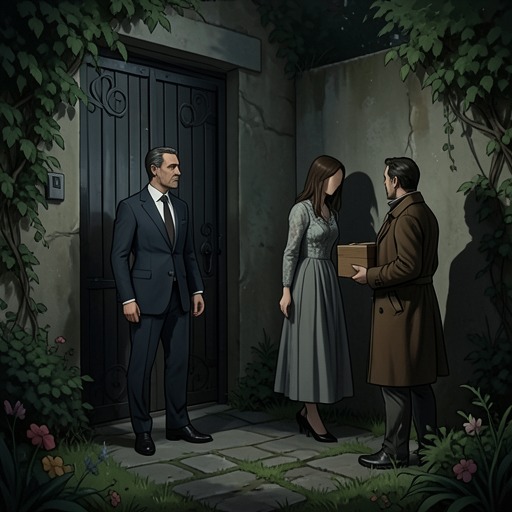
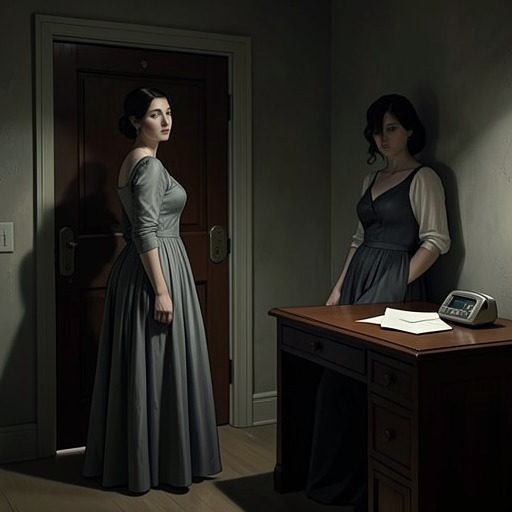
Olga reminds Fullerton that he had helped her with forms the previous year so she could remain in England for another year. She had come back to him expecting the kindness she remembered, and now asks for help while facing questions and the possibility of legal representation. Fullerton recalls answering coldly that her circumstances do not permit him to act for her: he is already the Drake family’s solicitor. His restraint is sharpened by pity, not by indifference. He does not accept Olga’s passionate arguments as a reason to abandon his professional position, but he is sorry for her.
He advises Olga that her best chance is to make a clean breast of things. She resists, insisting that admitting what he wants her to admit would mean telling lies: she says Mrs Llewellyn-Smythe made a will, wrote it down, and sent her out while the others signed. Fullerton points out that evidence exists that Mrs Llewellyn-Smythe sometimes did not know what she was signing and did not always reread documents. The exchange places his legal assessment against Olga’s own account without treating her insistence as proof that the codicil is authentic.
Fullerton’s reflections acknowledge the hardships Olga has endured, including the loss of family and the fear and injustice of life under a police state. He believes these experiences have intensified a childish, passionate greed in her. His sympathy is therefore not exoneration: he can understand something of her vulnerability and still see the forged document, the evidentiary case, and the limits of what he can do for her.
Witnesses and the Limits of the Documents
Later accounts complicate the distinction between a genuine act of making a will and a forged document used to obtain an inheritance. Harriet Leaman recalls Mrs Llewellyn-Smythe sending Olga from the room, covering the upper part of a paper with blotting paper, and asking Leaman and a young garden worker named Jim to witness her writing and signature. Leaman says Mrs Llewellyn-Smythe used a scratchy pen, signed the paper, and asked both witnesses to write their names and addresses. The account describes what the witnesses were asked to observe, but does not by itself establish that the paper was the codicil later submitted for probate.
After making a telephone call to Fullerton, Poirot clarifies that the forged codicil submitted for probate was witnessed not by Leaman but by Mary Doherty, a former servant who had died, and James Jenkins, who had gone to Australia. He also notes the possibility of a real codicil. The distinction is central to the legal puzzle: a witness’s memory of Mrs Llewellyn-Smythe signing a document cannot, without establishing which document it was and how it relates to the probate instrument, settle whether the codicil benefiting Olga was genuine.
Narrative Role
Fullerton supplies the investigation with the legal history that makes the forged codicil legible: the earlier pattern of inheritance, the unusual new beneficiary, the handwriting practice that provided a means of imitation, and the expert examination that exposed the forgery. His professional perspective separates suspicion about an inheritance from evidence about a document’s authorship. At the same time, his compassion keeps the case from becoming an abstract contest between a family and a suspected forger. Olga is both the person implicated by the evidence and someone who once sought his help; Fullerton’s refusal shows how personal pity can coexist with, but cannot replace, professional responsibility.